
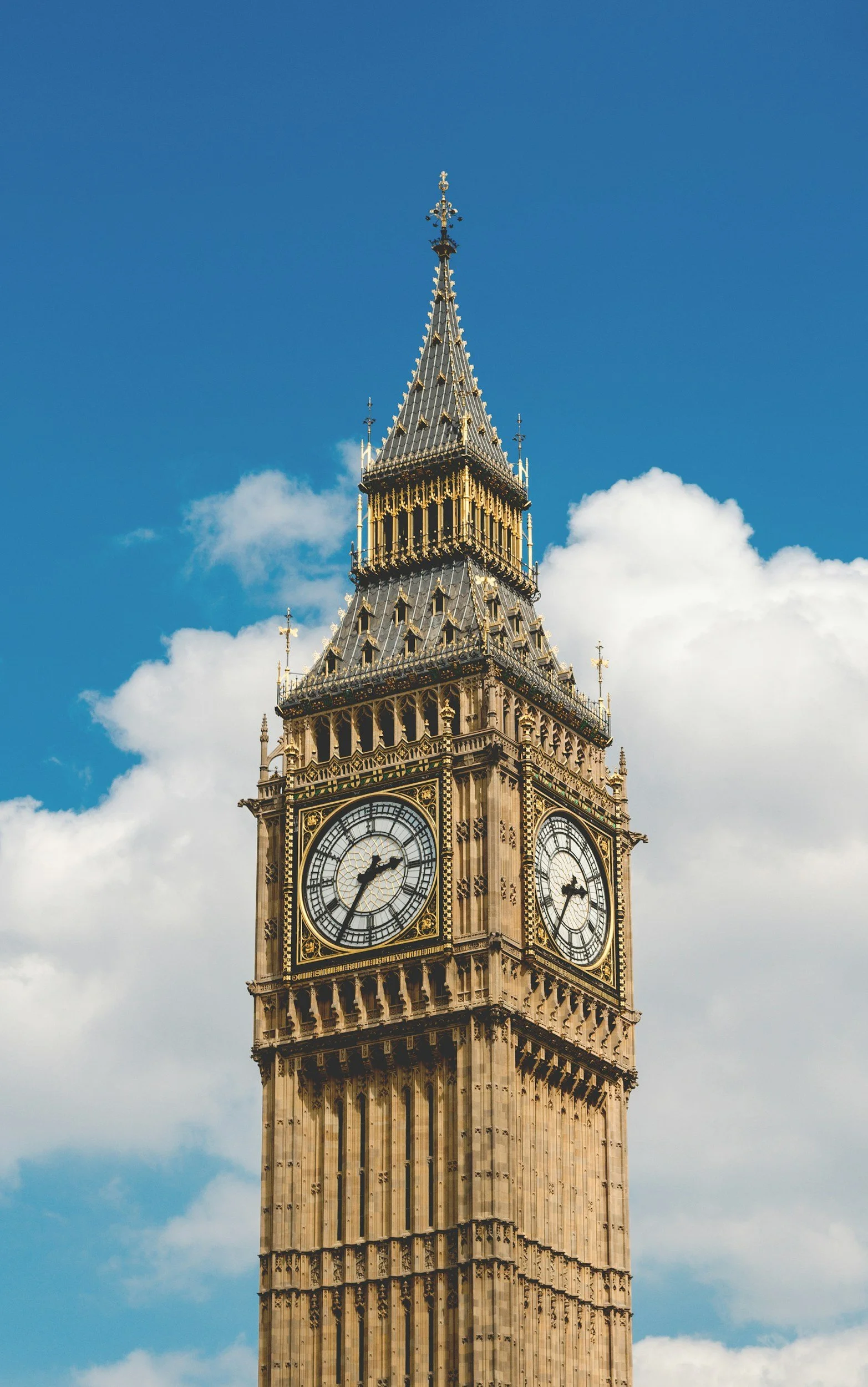
Big Ben is one of the most recognised landmarks in the world and a lasting symbol of London. Standing beside the Palace of Westminster, the tower and its clock have marked the passing of time for more than a century. While many people use the name “Big Ben” to describe the entire tower, the name originally referred only to the great bell inside. Over time, it has come to represent the clock, the tower, and the surrounding seat of government. (1)
Located in central London, Big Ben is closely linked to British history, politics, and daily life. It is part of the wider big ben palace of westminster london complex, which has played a central role in the country’s governance for centuries. (2)
The Origins and History of Big Ben
The story of Big Ben begins in the mid-19th century. After a fire destroyed much of the old Palace of Westminster in 1834, plans were made to rebuild the complex. Architect Charles Barry designed the new palace, while Augustus Pugin created the detailed Gothic design of the clock tower. Construction of the tower was completed in 1859. (3)
The great bell, later nicknamed Big Ben, was installed the same year. Its exact naming remains debated, but many historians believe it was named after Sir Benjamin Hall, a senior official involved in the project. Others suggest the name came from a well-known boxer of the time. Regardless of its origin, the name quickly became part of public language. (4)
From the beginning, the clock was designed to be accurate and reliable. Despite London’s weather, pollution, and heavy use, Big Ben has remained a trusted timekeeper. Even during wartime, it continued to operate, becoming a symbol of stability during difficult periods in British history. (5)
Big Ben and the Palace of Westminster
Big Ben stands at the northern end of the Palace of Westminster, home to the UK Parliament. The palace itself sits on the site of a former royal residence, used by English monarchs from the medieval period onward. Today, it houses the House of Commons and the House of Lords. (6)
The connection between Big Ben and British democracy is strong. The sound of the bell has marked key political moments, including elections, royal events, and national ceremonies. For many people, the image of Big Ben is inseparable from the idea of parliamentary government in Britain. (7)
Because of its importance, the entire big ben palace of westminster london area is protected as a UNESCO World Heritage Site. This ensures its preservation for future generations. (8)
The Big Ben Clock Face and Timekeeping
One of the most distinctive features of the tower is the big ben clock face. Each face measures over seven metres in diameter, making it one of the largest four-faced clocks in the world. The minute hands alone are more than four metres long. (9)
The clock uses a traditional mechanical system powered by weights and regulated by a pendulum. Coins are still used to adjust its timing, a method that allows for remarkable precision. Even today, this system keeps time within seconds. (10)
At night, the illuminated clock faces signal that Parliament is in session. This detail reflects the clock’s role not just as a timekeeper, but also as a symbol of government transparency and continuity. (11)
Big Ben Dimensions and Structure
The tower, officially renamed the Elizabeth Tower in 2012, rises approximately 96 metres high. These big ben dimensions include the spire and flagpole at the top. Inside, a narrow spiral staircase leads upward through the tower’s interior. (12)
The bell itself weighs over 13 tonnes and produces the deep sound heard across central London. Smaller bells accompany it, creating the familiar chime sequence broadcast around the world. The structure was built using brick, limestone, and cast iron, reflecting the engineering standards of the Victorian era. (13)
The Big Ben Climb Experience
Access to the tower is limited, but the big ben climb is possible for UK residents through guided tours. The climb involves more than 300 steps and requires a good level of fitness. There is no lift, and the staircase is narrow and steep. (14)
Those who complete the climb are rewarded with views of the clock mechanism and close access to the bell chamber. The experience offers a rare look inside one of Britain’s most important structures and helps visitors understand how the clock works from the inside. (15)
Location, Directions, and Nearby Landmarks
Big Ben is located in Westminster, close to the River Thames. Visitors often ask for big ben directions, as it sits at the centre of many major routes. The nearest underground stations are Westminster, Waterloo, and St James’s Park. (16)
The official big ben postcode is SW1A 0AA, which places it firmly within London’s political district. The area is busy throughout the day, with tourists, government staff, and local commuters passing through. (17)
A popular walking route connects big ben to buckingham palace, passing through St James’s Park. This short walk offers views of historic buildings, green spaces, and ceremonial routes used during royal events. (18)
Big Ben in Modern London
In recent years, Big Ben underwent extensive restoration work to preserve its structure and restore original details. The project ensured the clock and tower remain safe and functional for decades to come. The return of the bell’s full chime was widely celebrated across the UK. (19)
Today, Big Ben remains a key point of reference in London. It appears in films, books, and broadcasts, and it continues to mark national moments such as New Year celebrations and remembrance events. Despite the city changing around it, Big Ben remains constant. (20)
Visiting Big Ben with Private Travel Options
Exploring central London can be tiring, especially in busy areas like Westminster. Choosing private transport makes the experience easier and more comfortable, giving visitors flexibility and control over their schedule without relying on public transport.
This option suits families, small groups, and travellers with limited time. A private car allows smooth travel between Big Ben, the Palace of Westminster, Buckingham Palace, Westminster Abbey, and other nearby landmarks. It reduces walking distances, avoids crowded routes, and allows visitors to explore London’s historic centre at a relaxed pace. (21)
Big Ben
History, Significance, and Guide for Visitors
References
(1) Ackroyd, Peter. London: A History. Vintage, London, 2000.
(2) Collins, Mark. The Palace of Westminster. Batsford, London, 1999.
(3) Stamp, Gavin. Victorian Architecture. Thames & Hudson, London, 1990.
(4) Woodward, David. Great Bells of Britain. Shire Publications, Aylesbury, 2005.
(5) Gardiner, Juliet. Britain in the Second World War. Headline, London, 2004.
(6) Bryant, Chris. The Houses of Parliament. Profile Books, London, 2005.
(7) Colley, Linda. Symbols of British Democracy. Penguin, London, 2002.
(8) McDowall, David. UNESCO World Heritage in the UK. Frances Lincoln, London, 2010.
(9) Betts, Jonathan. Great Clocks and Watches. National Maritime Museum, London, 1997.
(10) Nye, James. Timekeepers of the World. Oxford University Press, Oxford, 1994.
(11) Norton, Philip. Parliament and Public Life. Routledge, London, 2008.
(12) Clark, Ronald H. Engineering the Victorian Age. MIT Press, Cambridge, 1985.
(13) Hobsbawm, Eric. Industrial Britain. Penguin, London, 1999.
(14) Thurley, Simon. Historic Buildings Access Guide. English Heritage, London, 2003.
(15) Saint, Andrew. Inside Britain’s Landmarks. Yale University Press, New Haven, 2006.
(16) Duncan, Andrew. Walking London. New Holland Publishers, London, 2007.
(17) Gray, Ian. Postcodes of Britain. Ian Allan Publishing, London, 2002.
(18) Parker, Matthew. Royal London. Weidenfeld & Nicolson, London, 2005.
(19) Feilden, Bernard. Conservation of Historic Buildings. Routledge, London, 2003.
(20) Hill, Rosemary. London Icons. Frances Lincoln, London, 2010.
(21) Page, Stephen. Urban Tourism and Transport. Routledge, London, 2008.