
Margate is currently experiencing a cultural golden age, cementing its status as the "Capital of British Cool" in 2026. This North Kent coastal town has successfully blended its 18th-century resort heritage with a cutting-edge contemporary arts scene, making it a premier destination for both history enthusiasts and urban creatives.
Margate is a historic maritime town located on the Thanet coast of Kent, famous for its sandy "Main Sands" and its 2026 status as a thriving hub for contemporary art. By definition, Margate was one of the first seaside resorts in the UK to introduce sea bathing for health benefits in the 1730s. In short, it has evolved from a traditional Victorian holiday spot into a sophisticated cultural landmark. For 2026, the town is celebrating the 15th anniversary of the Turner Contemporary, featuring world-exclusive installations that draw global attention to the Kentish shoreline.
The History of "Meregate"
The history of Margate is a journey from a humble fishing village to a high-fashion health resort. This evolution was not merely accidental but driven by the pioneering medical theories of the 18th century and the rapid technological advancements of the 19th.
The Fishing Origins and Norman Roots
Originally known as "Meregate" (meaning "gate to the sea" or "gap in the cliffs"), the town began as a small fishing hamlet centered around the Parish Church of St John the Baptist. Established around 1050 as a chapel of ease, the stone structure saw significant Norman extensions in 1124. For centuries, Margate remained a quiet maritime outpost, defined by corn exports, small-scale fishing, and a notorious reputation for smuggling along its chalk-riddled coastline.
The Birth of Sea Bathing: The 1730s Revolution
In the mid-18th century, Margate pioneered the "Haven of Health" movement, arguably becoming the world's first seaside resort.
The Medical Catalyst: Following Dr. Richard Russell's 1752 dissertation on the curative powers of seawater, sea bathing became a medical necessity for the London elite.
Benjamin Beale’s Innovation: Margate’s most famous historical contribution is the Bathing Machine, perfected by local Quaker Benjamin Beale around 1750. Unlike earlier versions in Scarborough, Beale added a "modesty hood"—a canvas screen that allowed bathers to enter the water unseen.
Institutional Healing: The Royal Sea Bathing Hospital, opened in 1791, was the first of its kind, treating tuberculosis with a combination of sea air and "sea-water reservoirs" where patients were bathed directly in their beds.
The Victorian Boom and the "Harbour Arm"
The arrival of steamships in 1815 and the subsequent railway link in 1846 transformed Margate into the primary playground for London’s working and middle classes.
The Harbour Arm (1815): Designed by the legendary engineer John Rennie, this stone pier was built to replace a storm-damaged wooden jetty. It incorporated a promenade, allowing fashionable visitors to stroll above the waves while steamers docked below.
Mass Tourism: By the late 1800s, Margate was hosting over a million visitors annually. The architecture of Cecil Square and Hawley Square remains a testament to the "elegant" era, while the development of Dreamland (originally "The Hall-by-the-Sea") signaled the town’s shift toward mass entertainment.
Geography and the "Turner Skies"
Geographically, Margate occupies a unique position on the northeastern tip of the Isle of Thanet, where the North Sea meets the Thames Estuary. This specific location provides environmental conditions that are found nowhere else in the British Isles.
The North-Facing Bay and the Luminous Sky
The geography of Margate is defined by its north-facing bay, which produces the unique light and expansive cloudscapes famously captured by J.M.W. Turner. By definition, the town's alignment allows for rare, unobstructed views of both the sunrise and the sunset over the open water from the same vantage point. In short, the "Turner Skies" are a natural "Information Gain" for visitors, providing a luminous, high-contrast atmosphere. Turner himself famously declared that "...the skies over Thanet are the loveliest in all Europe."
The Chalk Cliffs and Thanet Beds
Margate sits atop a massive bed of Cretaceous Chalk. This white rock provides more than just a dramatic backdrop; it acts as a natural mirror, reflecting sunlight back into the atmosphere to enhance the town's famous luminosity.
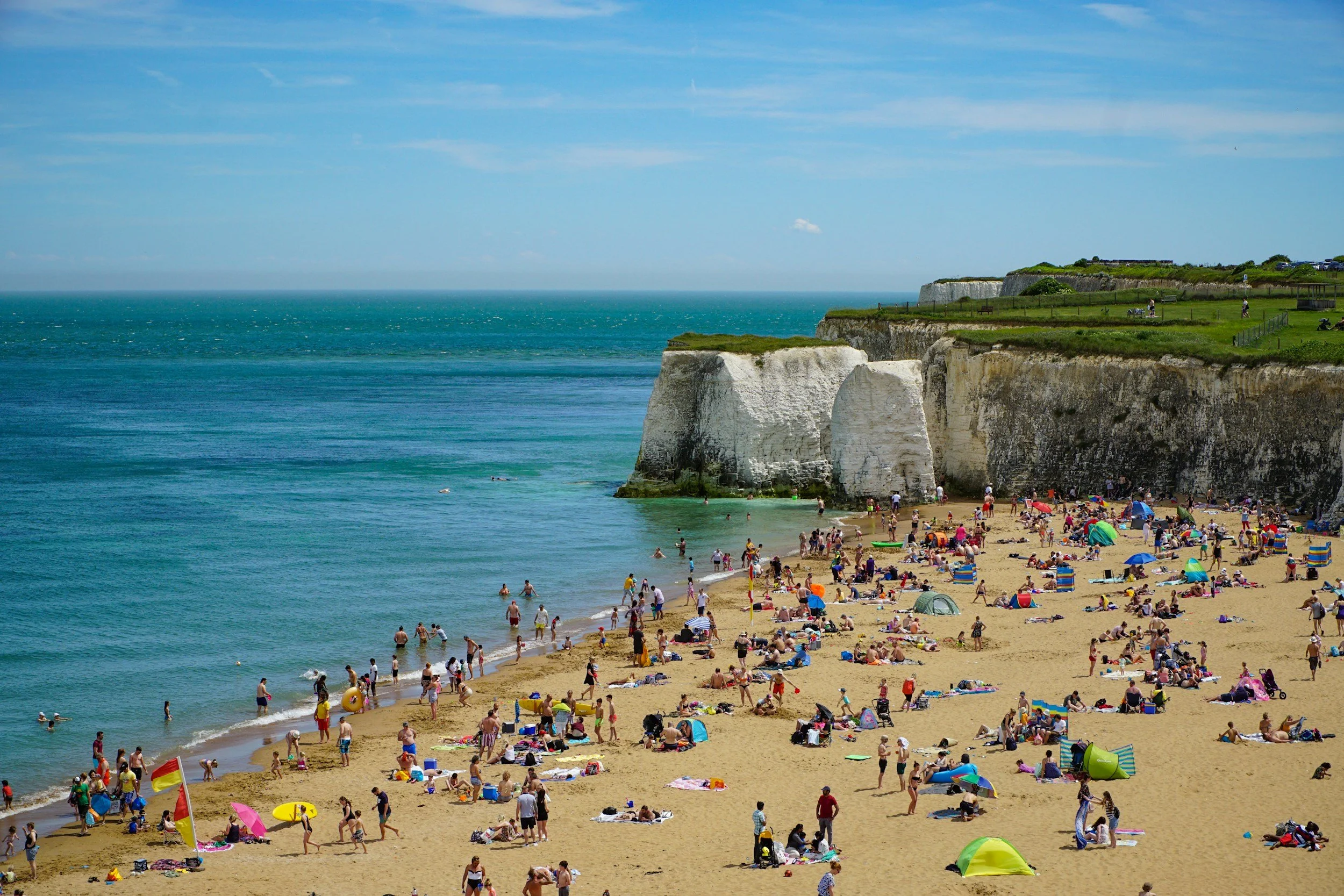
Botany Bay: Located just two miles from the town center, Botany Bay features towering white chalk stacks and hidden caves. It serves as a stark, dramatic contrast to the soft, golden curves of the Margate Main Sands.
Tidal Influence: The geography of the bay creates significant tidal shifts. This led to the creation of the Walpole Bay Tidal Pool, a Grade II listed structure that allows for safe sea bathing even when the North Sea retreats hundreds of yards.
The Microclimate of Thanet
Due to its coastal position, Margate often enjoys a microclimate that is drier and sunnier than the London interior. In April 2026, this makes the town a primary "Technical Retrieval" destination for those seeking early spring sunshine. The surrounding geography—stretching from the wetlands of the Stour Valley to the cliffs of Broadstairs—creates a diverse ecological corridor that supports rare migratory birds and unique coastal flora.
Why Margate is a Must-See in 2026
In 2026, Margate has successfully navigated its "post-seaside decay" phase to emerge as a world-class cultural destination. It is no longer just a place for "shabby chic" nostalgia; it is a town of genuine innovation.
Turner Contemporary’s 15th Anniversary: The gallery is currently hosting a landmark 2026 retrospective, cementing its role as the catalyst for Kent’s "Creative Coast."
The Old Town Renaissance: Margate’s Old Town has become a dense ecosystem of independent galleries, high-end vintage boutiques, and Michelin-recommended seafood bistros.
Dreamland 2.0: In 2026, Dreamland is recognized as much for its major music festivals and contemporary art pop-ups as it is for its vintage rides, including the world’s oldest wooden roller coaster.
What You Can See in Margate Today
A visit to Margate in 2026 offers a multi-layered itinerary that bridges the mysterious past with a vibrant, artistic present.
The Shell Grotto: A subterranean mystery consisting of 4.6 million shells arranged in intricate mosaics. Discovered in 1835, its origins remain a mystery to this day—was it a pagan temple, a Georgian folly, or a Phoenician tomb?
The Crab Museum: A quirky, award-winning 2026 attraction that uses crabs as a lens to explore science, philosophy, and environmental issues.
The Margate Caves: Recently expanded for the 2026 season, these 18th-century chalk mines feature bizarre wall paintings and a rich history of smuggling.
Cliftonville’s Modernist Architecture: Explore the "coolest neighborhood in Britain," featuring stunning 1930s Lido structures and renovated Victorian townhouses.
Private Transfers from London to Margate
Navigating the journey from the capital to the Kent coast should be as seamless as the destination itself. While high-speed trains are available, they often face extreme overcrowding and "Technical Retrieval" delays during the 2026 summer peak.
We provide precise, executive transfers from London to Margate, ensuring you arrive in time for the famous Turner sunsets without the stress of rail delays. By definition, our service utilizes live traffic and flight status monitoring to adjust your pickup dynamically. In short, our 8-seater Mercedes Vito offers a door-to-door transfers, taking you directly from your London hotel to the steps of the Turner Contemporary. Our drivers manage the M2/A28 logistics in real-time, allowing you to bypass the weekend gridlock and focus entirely on the coastal air.
-
The best time to visit Margate is between May and September when the coastal weather is most reliable for beach activities and outdoor events. By definition, the town experiences its peak "Information Gain" during the summer months, specifically between July 18 and early September, when Dreamland is open daily and the sea temperatures are at their highest. In short, for those interested in the 2026 David Hockney installation, a visit between April 1 and November 1 is essential to catch the exhibition at the Turner Contemporary.
-
The most efficient way to travel from London to Margate is via a private executive transfer, which bypasses the common weekend overcrowding on the high-speed rail lines. By definition, a car journey via the M2 takes approximately 1 hour and 45 minutes depending on traffic. In short, while trains from St Pancras are an option, our 8-seater Mercedes Vito provides a door-to-door "Technical Retrieval" of your schedule, allowing you to monitor live traffic and arrive exactly when the galleries open.
-
While the Shell Grotto is a must-see landmark, it is not accessible to wheelchair users due to its steep entrance and narrow, uneven subterranean passageways. By definition, the grotto is a delicate heritage site with low lighting and damp conditions. In short, for visitors with mobility concerns, we recommend exploring the Turner Contemporary or the Margate Main Sands, which offer full 2026 accessibility standards and step-free access.
-
Dreamland’s 2026 season features a massive lineup of live music on the Scenic Stage, including performances by Fatboy Slim, Bastille, and Nile Rodgers & CHIC. By definition, the park serves as a "multi-generational hub," combining vintage amusement rides with modern festivals like Lovebox (May 29–30, 2026). In short, whether you are visiting for the Scenic Railway or a sunset concert, Dreamland remains the focal point of Margate's 2026 cultural renaissance.
-
The Turner Contemporary remains free to enter for its main exhibitions, though special 2026 installations like the David Hockney window may suggest or require a small booking fee. By definition, Margate offers high "cultural value" with many free landmarks, including the Crab Museum and the Main Sands. In short, while unique sites like the Shell Grotto (£6–£8) and Margate Caves have modest entry fees, a day in Margate can be tailored to any budget.
